Case o' The Week: Lundin - "I hear you knocking . . . "
 “. . . .but you can’t come in.”
Players: Decision by Judge W. Fletcher, joined by Judges
Berzon and Bea, upholding suppression decision by ND Cal D.J. Tigar. Big win
for N.D. Cal Chief Ass’t Geoff Hansen and Research and Writing Attorney Steve
Koeninger.
Facts: Cops learned of a request for the arrest of
Eric Lundin. Id. at *2. At 4:00 a.m. they
went to Lundin’s home, stood on his porch, and knocked loudly on his door. Id. They heard crashing behind the
house, ran around, and discovered Lundin in the backyard. Id.
A search in the backyard and patio revealed a pair of handguns
that matched the description of guns used in an earlier alleged kidnapping. Id. Lundin was charged with being a
felon in possession, and moved to suppress the guns. Id. at *3.
District Judge Tigar granted the motion; the government
took an interlocutory appeal.
Issue(s): “[T]o show that exigent circumstances [relating to
the crashing sounds in the backyard] justified the warrantless search, the
government must show that the officers lawfully stood on Lundin’s front porch
and knocked on his door.” Id. at *4. “The
government contends that the officers were permitted to knock on Lundin’s door
under the so-called ‘knock and talk’ exception to the warrant requirement,
which permits law enforcement officers to encroach upon the curtilage of a home
for the purpose of asking questions of the occupants.” Id. at *5 (citation and quotations omitted).
Held: “For two
reasons, we agree with the district court that the officers exceeded the scope
of the customary license to approach a home and knock . . . .First, unexpected
visitors are customarily expected to knock on the front door of a home only
during normal waking hours.” Id. at
*5.
“Second, the scope of
the license is often limited to a specific purpose.” Id. “The ‘knock and talk’ exception to the warrant requirement does
not apply when officers encroach upon the curtilage of a home with the intent
to arrest the occupant.” Id. at *6.
“Thus, the officers
violated Lundin’s Fourth Amendment right to be free from unlawful searches when
they stood on his porch and knocked on his front door.” Id.
Of Note: Huge, huge win. But really nothing new or novel, in
this welcome opinion. Instead, Lundin
is the first Ninth case to really engage with Justice Scalia’s 2013 decision in Jardines.
District Judge Tigar (and,
on appeal, Judge Fletcher) considered the subjective
intent of the officers when they stomped onto Lundin’s porch at 4:00 in the
morning. Id. at *6. Judges getting
into the officers’ heads may raise eyebrows -- we’ve all been so browbeat by Whren’s horrible admonition, “Subjective
intentions play no role in ordinary, probable-cause Fourth Amendment analysis.”
But Judges Tigar and Fletcher aren’t plowing new Fourth fields -- it was Justice Scalia in Jardines who explained that the implied license for a “knock and
talk” depended on the purpose the
officers had for entering the curtilage. Id.
at *6. “Knock and talk” isn’t the only Fourth exception that looks to the “actual
motivations” of the officers – “special needs” and “administrative inspections”
also look at the intent of the police. Id.
at *6. (And, as discussed below, maybe other “implied license” cases trigger a
subject inquiry?)
How to Use:
Is it per se unreasonable for
officers to intrude upon curtilage at 4:00 a.m. for a “knock and talk”
exception? Judge Fletcher explains it not.
Maybe your client “sells fresh
croissants out of his home,” and “generally expects strangers on his porch
early in the morning.” Id. at *5.
Maybe the officers are warning your client that “a fox has gotten into the
resident’s henhouse.” Id. (a lovely,
subtle metaphor in this Fourth Amendment case).
These examples seem crazy? That’s
crazy deliberate. The Ninth is signaling that it will be the rare case indeed
where cops have a credible subjective intent for a “knock and talk” in the
middle of the night.
For Further
Reading: Cops’ subjective intent can matter for
“implied license” searches. Does that new(ish) Jardines’ reality bear on implied license searches in, for example,
email and Facebook? For post mulling that interesting question, see Some Thoughts on Jardines and Police Intent,
available here.
Image
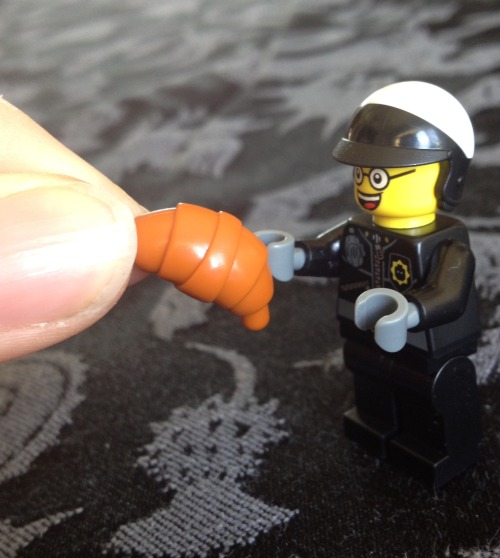
of Lego Cop with Croissant from https://41.media.tumblr.com/364fb49eec15ae92e3937f8a9e48ac37/tumblr_n3l38ln7bf1rnpm7mo1_500.jpg
Steven
Kalar, Federal Public Defender ND Cal. Website at www.ndcapfpd.org
.
Labels: Curtilage, Fourth Amendment, Implied License Searches, Knock and Talk, W. Fletcher
posted by Steve Kalar at 3/26/2016 07:30:00 AM
0 comments