Sunday, October 08, 2017

Case o' The Week: A Stitch in Twine Saves Nine (from reversing) - Spatig and Mens Rea in "Knowingly" Statutes

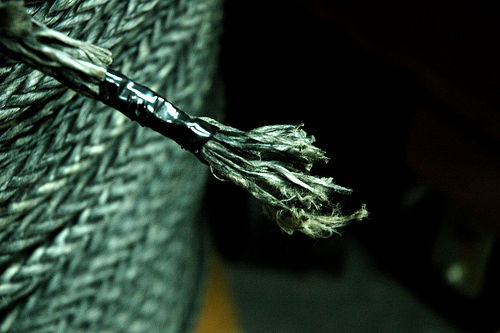
  Mens rea, frayed Twine, on Ninth's mind.
 United States v. Spatig, 2017 WL 4018398 (9th Cir. Sept. 13, 2017), decision available here.

Players: Decision by Judge McKeown, joined by Judge Nguyen and visiting 10th  Circuit Judge Murphy.
 Hard fought appeal by AFD Steven Richert, Federal Defenders Services of Idaho.

Facts: Spatig ran a company that ended up with lots of bulk paint and paint-related materials. Id. at *1. When Spatig’s wife became ill he stopped working and decided to store these materials at his Idaho residence (with no EPA permit). Id. County officials found the stuff in 2005 and destroyed much of it. Id.
  However, in 2010, hazardous materials were again found strewn across the property: corroded, rusted, and not stored safely. Id. An EPA team came in, removed over 3,000 containers, and spent almost half a million dollars on the clean-up. Id.
  Spatig was charged with knowingly storing and disposing hazardous waste, without a permit, in violation of 42 USC § 6928(d)(2)(A) (the “Resource Conservation and Recovery Act,” or “RCRA.”) Id.
  The government won an in limine motion to preclude evidence on Spatig’s diminished capacity, arguing the offense was a general-intent crime. Id. Spatig was convicted after trial.

Issue(s): “The key issue on appeal is whether § 6928(d)(2)(A) defines a crime of general or specific intent, as that decision dictates whether Spatig can advance a diminished-capacity defense. We have consistently held that diminished capacity defenses are not available to defendants who are accused of general intent crimes.” Id. at *2 (quotations and citations omitted).

Held: “[W]e affirm because § 6928(d)(2)(A) defines a general-intent crime.” Id. “Because § 6928(d)(2)(A) defines a crime of general intent, the district court did not err in excluding evidence of Spatig’s diminished capacity.” Id. *4.

Of Note: “But wait,” you protest, “what about Twine?” In that 1988 decision, Judge Brunetti looked at a pair of statutes that prohibited knowingly conveying a threat – the same operative verb in the charge facing Spatig. See United States v. Twine, 853 F.2d 676 (9th Cir. 1988). The Court held that those statutes required an “intent to threaten,” and thus required “specific intent.” Id. at 680.
  Judge McKeown is unpersuaded.
  Twine, Judge McKeown concludes, covers offenses that are “akin to ‘classic’ specific-intent crimes,” while the hazardous waste statute in Spatig is “agnostic” as to the defendant’s aim. Id. at 2017 WL 4018398 at *3.
  The Court also takes a swipe at Twine, opining that the Ninth has “softened on the reasoning” of the decision and reporting the circuit split engendered by the case. Id. at *3 & n.2.
  It is a disheartening discussion for those on all sides of the political spectrum who worry about federal prosecutions in a strict liability world, checked only by prosecutorial discretion.   

How to Use: Good Conservatives (well, at least, good Federalists) distrust the regulatory state and worry about the constant erosion of mens rea requirements in federal criminal statutes and regs. As President Trump’s judicial appointees join the district courts and Ninth (and more Justices join the Supreme Court), the time is ripe for a renewed mens rea effort by the federal defense bar.
   More immediately, and despite the discounting of the Spatig panel, note that Twine remains good law. Spatig’s “akin to classic specific-intent” distinction of Twine feels like an awfully fuzzy test. When advocating for specific intent for a “knowingly” statute, brush off your copy of Reading Law, channel Justice Scalia’s originalism vibe, and root about old common law for “classic” specific-intent analogues that are arguably “akin” to offenses in “knowingly” statutes.   
                                        
For Further Reading: “The Supreme Court has long recognized a ‘presumption’ grounded in our common law tradition that a mens rea requirement attaches to ‘each of the statutory elements that criminalize otherwise innocent conduct.’”
  Who penned these wise words?  Then-Judge, now-Justice Gorsuch. See Neil Gorsuch on criminal defendants and the rule of law, available here. 


Steven Kalar, Federal Public Defender, Northern District of California. Website available at www.ndcapfpd.org


.

Labels: , , , , ,

Sunday, October 31, 2010

Case o' The Week: Defense Appeals Acquittal - and Loses; Vela and NGI appeals

Judge Canby's decision in Vela, complains dissenting Judge N. Randy Smith (right), will allow the defense to "have its cake and eat it too," and to get a "do over" when a defense strategy does not pan out at trial.

Works for us.

United States v. Vela
, 2010 WL 4188983 (9th Cir. Oct. 26, 2010), decision available here.

Players:
Hard-fought appeal by San Diego AFPD Todd Burns. Decision by Judge Canby, dissent by Judge N. Smith.

Facts: Vela, plagued with delusions about persecution by the Mafia and his family, interacted with a Customs Agent – then severely injured the agent by stabbing him in the chest. Id. at *1. Vela went to trial on a count of 18 USC § 111, assault on a federal officer. Id.

The indictment didn’t allege a “willful” assault, and the court refused a pretrial challenge on that alleged missing “element.” Id. The district court also rejected a diminished capacity defense, and an Apprendi challenge. Id. Vela was found not guilty by reason of insanity at trial, then committed to a mental facility in the custody of the A.G.. Id. “Vera timely appealed the judgment.” Id.

Issue(s): “[T]he government’s contention [is that] we lack jurisdiction because there is no final judgment from which Vela can appeal.” Id. at *2. Vela “contends that the district court erred in failing to dismiss the indictment, refusing to instruct the jury that willfulness is an element of § 111, and denying him the opportunity to present a diminished capacity defense. He contends that, as a result, he was denied an opportunity for an outright acquittal rather than a verdict of not guilty by reason of insanity, which results in civil commitment.” Id. at *1.

Held: “We conclude in this matter of first impression that, when a defendant is found not guilty by reason of insanity, the lack of a sentence does not necessarily preclude appellate jurisdiction.” Id. at *2. “Vela’s arguments [that § 111 requires a heightened mens rea for conviction, and that the diminished capacity defense therefore lies], are foreclosed by our decision in United States v. Jim, 865 F.2d 211, 215 (9th Cir. 1989), where we held that § 111 is a general intent crime.” Id. at *4.

Of Note: The big new rule of Vela is the ability to appeal after a verdict of “not guilty by reason of insanity” (N.G.I.). An intriguing side issue, however, is the Apprendi challenge to the federal assault statute. In 1991, the Ninth held that Section 111 – the assault statute – has a sentencing factor within it: whether the defendant used a dangerous weapon. Id. at *6. The Ninth explained that the judge could find that fact, kicking the stat max for the crime up to twenty years. Id.

Then Apprendi came down in 2000, and required that any enhancement fact that increases the stat max to be proved to the jury. Id. Faced with Apprendi, the panel in Vela now saves the federal assault statute by suddenly converting a former sentencing factor into an element. Id. at *7-*8.

Did the language of the assault statute change since the Ninth’s 1991 decision? Nope – and the legislative history didn’t either. The analysis supporting this flip-flop on the meaning of the assault statute in Vela is precisely as compelling as it was when the Ninth similarly salvaged the federal drug statute in Buckland in 2002 – not the Circuit’s finest hour.

How to Use: Dissenting Judge N. Smith gives a great primer on how the defense can “have its cake and eat it too.” Id. at 10. As Judge Smith grumbles, Vela allows a defendant to appeal “one failed affirmative defense, while keeping his acquittal verdict as a back up.” Id. Sadly, Vela isn’t quite the defense bonanza that Judge Smith describes: counsel for a mentally-ill defendant must still worry about indefinite civil commitment whether pursuing a dim cap or insanity defense (a danger not fully acknowledged by either Judge Canby or Judge Smith).

The availability of appellate review after Vela does help us to untangle the Gordian knot we face when weighing whether to pursue a N.G.I. defense. Of course, bear in mind that while Mr. Vela won on j/x, he actually lost his appeal – taking a little of the urgency out of Judge N. Smith’s “sky is falling” dissent.

For Further Reading: Diminished capacity, and N.G.I., are two very different concepts: a point emphasized by Judge Canby in lengthy footnote in Vela. Id. at *6 & n. 11. For an interesting and detailed (though ultimately disappointing) Posnerian exegesis on just how complicated N.GI. is, see Morgan v. Israel, 735 F.2d 1033 (7th Cir. 1984) (upholding denial of federal habeas petition), decision available here.


Image of the Honorable N. Randy Smith from http://georgewbush-whitehouse.archives.gov/infocus/judicialnominees/n-smith.html


Steven Kalar, Senior Litigator N.D. Cal. FPD. Website at www.ndcalfpd.org


.

Labels: , , , , , , , ,