Sunday, February 16, 2020

Case o' The Week: Theft With No Steal Still Loses Appeal - Gagarin and Aggravated Identity Theft


  What is the the difference between identity theft, and identity fraud, in the Ninth?
   Five letters (and two years).
   United States v. Gagarin, 2020 WL 727761 (9th Cir. Feb. 13, 2020), decision available here.


 Players: Decision by Judge Gould, joined by Judge Bea. Concurrence by Judge Friedland. Hard fought appeal by ND Cal Appellate Chief Carmen Smarandoiu.  

Facts: Karen Gagarin participated in an insurance fraud conspiracy. Id. at *1. Gagarin’s cousin, Gilroy, asked Gagarin to secure a policy for her. Id. at *3. Gilroy testified that Gagarin instructed her to lie about her place of employment. Id. The application, apparently submitted by Gagarin, contained false information about employment, salary, and the nature of Gilroy’s relationship with the beneficiary. Id. There were several electronic signatures purporting to be by Gilroy. Id. at *2.
  Gagarin was convicted after trial of, among other counts, aggravated ID theft for the Gilroy application, in violation of 18 USC § 1028A. Id.

Issue(s): “Gagarin challenges the district court’s denial of her post-trial motion for a judgment of acquittal on the aggravated identity theft count . . . .” Id. at *1. “Gagarin claims that three essential elements were not satisfied, contending that (1) she did not ‘use’ a means of identification ‘during and in relation to’ the commission of wire fraud under the terms of the statute, (2) she did not act ‘without lawful authority,’ and (3) she did not use the means of identification of ‘another person.’” Id. at *4.

Held: “Gagarin attempt[ed] to pass herself off as her cousin through forgery and impersonation. . . . . [T]he use of another person’s means of identification makes a fraudulent claim for payment much harder to detect. . . and Gagarin’s forgery of her cousin’s signature did just that by obscuring her own role in the fraudulent application. Her use of Gilroy’s means of identification was thus central to the fraud and ‘furthered and facilitated’ its commission. [W] e hold that Gagarin’s actions constituted ‘use’ under the meaning of the aggravated identity theft statute.” Id. at *4 (internal quotations and citations omitted).
  “Gagarin also contends that she did not act ‘without lawful authority, a required element of aggravated identity theft. We disagree. . . . Whether a particular use was ‘itself illegal’ relates to the degree of connection between the use of the identity and the predicate felony. But the statute already contains language about the required nexus: the use must be ‘during and in relation to’ specified unlawful activity. Here, for the reasons stated above, Gagarin used Gilroy’s identity during and in relation to the wire fraud that Gagarin does not challenge occurred here. Gagarin has not shown that use ‘without lawful authority’ required more in this case.” Id. at *5.
  “[E] ven if Gagarin had Gilroy’s consent, we follow our circuit precedent to hold that Gagarin used the means of identification of ‘another person’ by using the identification of another ‘actual person.’ Id. at *6.

Of Note: Supervise an intern? That can earn you +3 offense levels for being a manager or supervisor. Id. at *7. The Ninth’s affirmance of this sentencing enhancement is another disappointing aspect of a frustrating opinion.

How to Use: In a thoughtful decision, the Seventh Circuit narrowed this expansive statute by limiting the term, “another person” to refer to a person who did not consent to the use of the means of identification.” See United States v. Spears, 729 F.3d 753, 758 (7thCir. 2013) (en banc). Gagarin author Judge Gould makes a point of criticizing the Spears analysis. Id. at *6.
  In a brief, but insightful, concurrence, Judge Friedland muses that the Seventh actually seems to have gotten it right. Gagarin, 2020 WL 727761, at *10 (Friedland, J., concurring).
  Read Judge Friedland’s concurrence and preserve the challenge when faced with a § 1028A charge that – like here – involved a person who consented to the use of an identity. Judge Friedland’s valid concerns may someday win the day.
                                               
Attorney General William Barr
For Further Reading: Turns out that we and DOJ agree: the Guidelines are far too harsh, line-AUSAs do seek far too much custody time, and reasonable sentences should involve far less incarceration.
   For one of many summaries of last week’s stunning Stone sentencing saga, see a NBC News article here
  Here’s hoping your federal client is the subject of a sympathetic White House Tweet, and a helpful sentencing-mitigation memo from Attorney General Barr.


Image of “You Can’t Steal Something That’s Been Given To You” from https://www.magicalquote.com/seriesquotes/cant-steal-something-thats-given/

Image of the Honorable Attorney General William Barr from https://en.wikipedia.org/wiki/William_Barr 


Steven Kalar, Federal Public Defender N.D. Cal. Website at www.ndcalfpd.org

.

Labels: , , , ,

Sunday, October 13, 2019

Case o' The Week: Ninth's Decision is Clear and Convincing -- Valle and Sentencing Standard of Proof

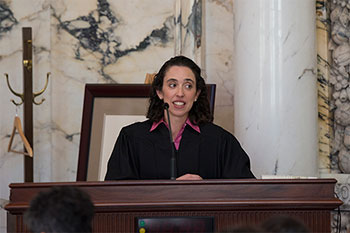
Hon. Judge Michelle Friedland

  Judge Friedland decides a continuous, ten year, debate. United States v. Valle, 2019 WL 5058604 (9th Cir. Oct. 9, 2019), decision available here.

Players: Decision by Judge Friedland, joined by Judge M. Smith and DJ Bastian. 
  Very nice victory for Deputy Federal Public Defender Brianna Mircheff, C.D. Ca. FPD.   

Facts: In ’98 and 2000, Valle was convicted of drug felonies and removed from the U.S. Id. In 2004, Valle was arrested for a DUI in California, but was not convicted or removed. Id. at *2.
  In 2017, Valle was again arrested by local police, he was charged with illegal reentry, and plead guilty. Id. The guidelines carried additional enhancements if his state drug convictions were within ten and fifteen years “of the start of his illegal reentry offense.” Id.
  Over defense objection, the PSR started the clock at the 2004 DUI arrest, despite the fact that there was no evidence about how many times Valle had departed and reentered the U.S. since that date. Id. This “start date” issue made a 30+ month difference in the guideline range, from the defense’s view of a range of 1-7 months to a PSR-urged term of over three years. Id.
  The government agreed with the PSR, and argued Valle’s previous use of California addresses and his family ties created a sufficient inference to conclude that he had continuously been in the US since 2004. Id. at *3. The district court agreed. Id. The court held as a matter of law that Valle’s continuous presence in the United States was not required [a legal error], and found that under a “preponderance of evidence” standard Valle had continuously been in the US from ‘04. Id. at *3 and *6.
  The court imposed a guideline sentence of 37 months. Id. at *3.

Issue(s): “This appeal requires us to evaluate the Government’s burden of proof in demonstrating the applicability of sentencing enhancements for an illegal reentry crime. Specifically, we consider whether the Government can establish by clear and convincing evidence a non-citizen’s continuous presence in the United States since the alleged time of reentry without submitting any direct evidence of where the non-citizen was for more than a decade.” Id. at *1.

Held: We hold that it cannot. We give some weight to the inference that a non-citizen who had previously returned after being removed and who had family in the United States would have made efforts to stay in the country. But that inference is not enough to carry the Government’s burden here to prove the thirteen years of continuous presence in the United States necessary to support the enhancements applied to . . . Valle’s sentence. We therefore vacate and remand to the district court for resentencing.” Id.
  “[B]ecause it was the Government’s significant burden to prove that Valle was continuously present, and it produced no evidence whatsoever about where he was for over a decade, the district court clearly erred in concluding that the Government had sufficiently proven that he remained in the United States.” Id. at *8.

Of Note: Valle won for now, the Ninth pointed to lower guidelines, but so what? Won’t the government just scrape together evidence of “continuous presence,” for re-sentencing?
  Nope!
  In a great holding, Judge Friedland concludes that because the government “failed to carry its burden despite an extensive factual inquiry below, it is not entitled to “a second bite at the apple.” Id. at *8. (internal citations and quotations omitted). Valle’s new range is 1-7, he’s been in for twenty, so the mandate was ordered transmitted “without delay” for immediate resentencing. Valle “second bite” holding is an interesting arrow for our appellate quivers.

How to Use: The key to this victory is the Ninth’s holding that the government’s sentencing burden was not by a preponderance, but by the higher “clear and convincing” standard. See id. at *4 - *5. In so doing, Judge Friedland carefully distinguishes other “preponderance” decisions. Id. at *5. Her analysis is invaluable for our future “clear and convincing” efforts -- turn to Valle when hunting for a heightened sentencing standard.  
                                               
For Further Reading: One out of three federal defendants sentenced last year was convicted of an immigration offense. 


So reports the Sentencing Commission, in its 2018 Annual Report. For a quick summary of the Feds’ new focus, see  article here


Pie chart of federal sentencing in 2018 from 2018 Annual Report and Sourcebook of Federal Sentencing Statistics. , reproduced here: https://www.washingtonexaminer.com/washington-secrets/feds-immigration-top-us-crime-one-third-of-all-sentencings


Steven Kalar, Federal Public Defender N.D. Cal. Website at www.ndcalfpd.org

.

Labels: , , , ,

Saturday, April 06, 2019

Case o' The Week: Protection sans Objection - Haines and FRE 412 Evidence


  The Federal Rules of Evidence cannot be used as both a sword and a shield.

  (By the defense).
United States v. Haines, 918 F.3d 694 (9th Cir. Mar. 14, 2019), decision available here.

Players: Decision by visiting District Judge Adelman, joined by Judges Wallace and Friedland.  

Left to right, the Honorable Judges Wallace and Friedland, and the Honorable District Judge Adelman
Facts: Haines and his friend King were charged with transporting two minor females from Nevada to California to work as prostitutes. Id. at 696. Over time, the girl alleged to have worked for Haines changed her story to the Feds. By trial, she testified that she did not prostitute for Haines and that her grand jury testimony was false. Id. Instead, she testified that she worked independently. Id.
   At trial, Haines attempted to question the girl about her prior prostitution activities (that did not involve a pimp), arguing that this was relevant to the question of whether he recruited her or encouraged her to engage in prostitution. Id. The district court excluded this testimony under Federal Rule of Evidence 412, the “rape shield” rule. Id.
  Haines was convicted, and appealed.

Issue(s): “Haines argues that evidence of J.C.’s prior prostitution activities should have been admitted under the exception to Rule 412 for 'evidence whose exclusion would violate the defendant's constitutional rights'—here, his due process right to present a complete defense and his Sixth Amendment right to confront witnesses.” Id. at 697.

Held: “[I]n cases involving adult victims forced or coerced into prostitution, courts have rejected such arguments, concluding that evidence of other prostitution activity has little or no relevance. Courts have reasoned that just because a victim agreed to engage in sex for money on other occasions does not mean she consented to, e.g., being beaten or having her earnings confiscated by the defendant.” Id. at 697-89 (citations omitted).
  “Haines cites no case holding that a defense such as the one he sought to present here triggers the exception in Rule 412. And we see no reason to depart from the persuasive authorities set forth above that held to the contrary.” Id. at 698-99.

Of Note: The unusual fact in Haines was that the female victim-witness for this Fed. R. Evid. 412 brouhaha was putatively a defense witness. She had recanted her grand jury testimony by the time of trial (after a jailhouse call from Haines, unfortunately). Atypically, the witness wasn’t objecting to the admission of this prior-prostitution evidence by Haines. The government was therefore using Rule 412 not as a shield, to protect a witness’s privacy, but as a sword, to prevent a defendant from eliciting favorable testimony “from a recalcitrant witness.” Id. at 699.
  No matter, concluded the Ninth, in a disappointing limitation on a defendant’s constitutional right to present a defense. “[A]llowing the victim’s wishes to control opens the door to mischief.” Id.      

How to Use: The narrow window left open on this type of “prior prostitution” evidence is when the government “opens the door” by suggesting that an alleged pimp introduced a minor to prostitution (that she was “an innocent lamb led to the slaughter).” Id. at 700. The Ninth holds this door wasn’t opened in the Haines case, in part because the district court warned the government against this line of evidence and argument.  The Court seems to recognize, however, that this type of evidence could be admissible if made relevant by the government’s approach.
                                               
For Further Reading: On March 26, the Senate confirmed President Trump’s nomination of the Honorable Magistrate Judge Bridget Bade, of Phoenix, to the Ninth Circuit Court of Appeals. See press release here
  Judge Bade will be joining two confirmed Ninth Circuit Trump nominees: the Honorable Judge Mark Bennett of Hawai’i, and the Honorable Judge Ryan Nelson of Idaho. See Ninth Circuit chart here
 Two additional Ninth nominees cleared the Senate Judiciary Committee on April 4, 2019: Mr. Daniel Collins, of L.A.’s Munger, Tolles & Olson, and Mr. Daniel Lee, of L.A.’s Jenner & Block. See article here


Image of (skeptical) United States v. Sha-Ron Haines panel from https://www.youtube.com/watch?v=akIGK_oYmIw


Steven Kalar, Federal Public Defender N.D. Cal. Website at www.ndcalfpd.org


.

Labels: , , , , ,

Sunday, November 04, 2018

Case o' The Week: A Western Gunn battle -- Ornelas and Mens Rea for Federal Attempted Robbery


   A Ninth Circuit panel, the defendant, and an Officer all wrestled over dangerous Gunn.

Mr. Jesus Eder Moreno Ornelas
   
 (No one badly hurt, thankfully).
  United States v. Ornelas, 2018 WL 5289024 (9th Cir. Oct. 25, 2018), decision available here.

Players: Decision by Judge Friedland, partial concurrence and partial dissent by C.J. Thomas.
  Compelling dissent by DJ Zilly, on defense-expert disclosure issue.
  Yet another notable win for former CD Cal AFPD Carl Gunn.

Facts: Mr. Moreno Ornelas and Forest Service Officer Linde got into dramatic fight after a routine stop near the Mexican border. Id. at *1. 
  According to Officer Linde, Moreno attacked him and knocked him out, grabbed his gun, and tried to shoot the officer. Id. at *2. Moreno then tried to steal Linde’s Forest Service truck. Linde testified that he ultimately prevailed and arrested Moreno at gunpoint. Id. 
  According to Moreno, he compiled with Linde’s orders to sit and be handcuffed, but the officer kept a gun trained on him with a finger on the trigger. Id. Fearing for his life, Moreno wrestled for the gun, emptied the chamber by firing into the air, then ran for the truck to escape. Id. 
  Among many other crimes, Moreno was charged with attempted robbery of the Officer's gun and the Forest Service truck. Id. (18 USC Sec. 2112). 
  Although the defense requested mens rea instructions, it did not object when the court instructed the jury and failed to require the specific intent to steal. Id. at *3. 
  Moreno was convicted by the jury on most counts, including the Section 2112 attempted robbery, and sentenced to 43 years. Id.

Issue(s): “On appeal, Moreno maintains that the district court plainly erred in two ways in instructing the jury on the elements of attempted robbery under § 2112: 
  (i) by failing to instruct that Moreno must have possessed the specific intent to steal; and 
  (ii) by failing to instruct that Moreno must have formed such intent by the time he used force, not just by the time he tried to take the property in question.” Id. at *3.

Held:We agree with the first contention but reject the second.” Id. “Although the district court was correct not to instruct the jury that Moreno must have formed the specific intent to steal by the time he used force, the court was wrong—and plainly so—to omit an instruction on specific intent altogether.” Id. at *4.
  “Congress’s use of the common law terms ‘robbery’ and ‘attempted robbery’ in § 2112 imported the common law meanings of those terms. The district court therefore should have instructed the jury that, to convict Moreno of attempted robbery, it needed to conclude beyond a reasonable doubt that he had formed the specific intent to steal the gun and truck by the time he tried to take them, though not necessarily by the time he used force against Linde. And, given the well-settled elements of common law robbery as well as Carter’s clear indication that § 2112 incorporates the common law, failing to instruct the jury on specific intent was an obvious omission.Id. at *5.

Of Note: Another issue in this complex appeal was the preclusion of a late-disclosed defense expert. Id. at *9.
  Suffice it to say, don’t be late. Id. at *11 (“Because he did not come close the meeting the district court’s reasonable deadline, Moreno was properly left to proceed without his desired expert testimony.”) 
  Somewhat lost in this bigger opinion is a compelling dissent by WD Wa. District Judge Zilly. Id. at *12. Judge Zilly - who is in the district court trenches every day - has the better argument. If caught in this exclusion bind, take a look at Judge Zilly's dissent while attempting to distinguish this Ornelas outcome.  

How to Use: Moreno earned a reversal on the mens rea instruction, but lost on another instruction challenge. At trial, he sought a specific theory-of-the-defense instruction on self-defense. The district court refused, and gave the Ninth’s general self-defense instruction. In a detailed analysis, Judge Friedland concludes that this was not error. Id. at *7-*8.
  Along the way, Judge Friedland delivers a decision of first impression on the general adequacy of the general self-defense instruction. Id. at *8.
  Eyeball Ornelas if considering a self-defense or justification theory: the opinion is likely to impact your run at specific theory-of-the-defense instructions.
                                           
For Further Reading: On October 18, Judge Ryan D. Nelson became the second Trump appointee to join the Ninth Circuit. See Ninth Circuit jurist listing here
The Hon. Judge Ryan D. Nelson

For a general background on the Ninth’s newest jurist, see blog post here
  President Trump has also nominated three additional nominees to the Ninth (to the considerable chagrin of a pair of powerful California Senators). See CNN article here


Steven Kalar, Federal Public Defender. Website at www.ndcalfpd.org

.

Labels: , , , , , , , , ,

Sunday, July 23, 2017

Case o' The Week: Ninth Throws the Book(ing Q's) at 'em - Zapien and the "Booking" Exception to Miranda

 This time, “book ‘em” . . . . (and use their custodial statements against ‘em, too).
 United States v. Zapien, 2017 WL 2836162 (9th Cir. July 3, 2017), decision available here.

Players: Per curiam decision with Judges McKeown, Friedland, and D. Nevada District Judge Boulware.  

Facts: Zapien was arrested, Mirandized accused by DEA agents of being a drug dealer, and he invoked his right to counsel. Id. at *1. The agents switched up and began asking custodial, or “booking,” questions -- Zapien then said he wanted to provide additional information. Id. Zapien was Mirandized again, explained he wanted to talk – and then admitted he’d been involved in drug trafficking. Id. Over defense objection, the district court permitted the questions on the theory that the biographical questions did not constitute interrogation. Id. Zapien was convicted of meth charges after a jury trial and sentenced to ten years. Id. at *2.

Issue(s): “On appeal, Luna Zapien challenges the district court’s denial of the motion to suppress . . . . Luna Zapien argues that the questioning following his invocation of his right to counsel constituted interrogation.” Id. at *3.

Held: “We disagree. We conclude that the questioning was covered by the booking exception.” Id.

Of Note: Whether the “booking exception” applies is an intensely fact-bound inquiry. Here, the booking questions didn’t relate to the charged offense, there was no evidence that the agents played upon Zapien’s weaknesses or knew that he was particularly disoriented or upset, or no facts in the record that the agents used the booking questions as a pretext. Id. at *4. The panel also collects other fact patterns, looking at both booking questions and their context. Id. 
  The Zapien outcome is what it is, and the panel carefully portrays the DEA agents as boy scouts scrupulously respecting Miranda protections. As a practical matter, however, when it is investigating agents – and not U.S. Marshals –asking these “booking” questions, and when these agents are launching into these “booking” questions right on the heels of a defendant’s solid invocation, we who represent indigent clients know that this “booking exception” is an inevitable subterfuge of Miranda protections.   

How to Use: Two footnotes may provide a foothold to distinguish Zapien in future “booking exception” cases. First, the per curiam decision dodges the (apparently unresolved) question of whether the government, or the defense, bears the burden of “establishing the applicability of the booking exception.” Id. at *4 & n.1 On a case with closer facts, tagging the government with that burden may save the day. (And really, how can it not be the government’s burden, to show invoke an exception and dodge Miranda limits?)
  The panel is also careful to note that there was no indication that Zapien’s undocumented status (discovered during the booking questions) was “used or leveraged” by the agents. Id. at 4 & n.2. Watch for the abuse of that fact – discovered during booking – even where (as here), undocumented status is not an element of the charged offense.
                                               
For Further Reading: How will the richest and most powerful country in history treat the poorest, and most vulnerable, among us?
  That question may be answered in San Francisco.


  On Tuesday, July 18, the acting director of ICE pledged to target Sanctuary Cities with new waves of ICE agents, to apprehend undocumented aliens. See article here
  Two days later, the Honorable District Judge William Orrick (N.D. Cal) denied the federal government’s motion for reconsideration of his Sanctuary City order: his refusal to dismiss the civil suits of Bay Area Sanctuary Cities stands. See Ord. here.  Judge Orrick also concluded that the City of San Francisco stated a sufficient claim for declaratory relief. Id. at 2:9-10.
   Yesterday, Attorney General Sessions gave a speech in Philadelphia and called on local governments to assist the “crackdown on illegal immigration.” See article here
   Fitting that our city, named for Saint Francis of Assisi, has become an epicenter for this brewing immigration battle.


Steven Kalar, Federal Public Defender, N.D. Cal. Website at www.ndcalfpd.org


.
.

Labels: , , , ,

Sunday, May 07, 2017

Case o' The Week: Ninth Inspired When Counsel Not Fired - Velazquez and Motions for New Counsel


The Honorable Judge Michelle Friedland

  As any experienced district judge knows, some prosecutions are two-attorney cases.
  And some, explains the Ninth, are three.
United States v. Velazquez, 2017 LEXIS 7674 (9th Cir. May 1, 2017), decision available here.

Players: Decision by Judge Friedland, joined by Judge Kozinski and (Sixth Circuit) Judge Gilman.

Facts: Guadalupe Velazquez, a teenager attending Arizona State University on a scholarship, dated a man involved in a marijuana importation conspiracy. Id. at *3. She was charged federally, along with her boyfriend and a dozen or so others. Id. at *4. 
  Her first appointed withdrew after an irreconcilable conflict. Id. 
  Her second attorney, Countryman, was appointed. Id. Countryman missed a deadline to file a suppression motion. Id. Velazquez filed a pro se motion seeking new counsel, citing the missed deadline. She also filed pro se motions related to discovery, trial timelines, and jurisdiction. Id. All motions – including the request for a hearing on new counsel – were denied. Id. at *6. 
  Velazquez later renewed her motion for new counsel. Id. at *8. A magistrate judge engaged in a long dialogue with Velazquez (recounted at length), where the defendant detailed her dissatisfaction with her counsel. Id. at *8-*22. The court continued the hearing. 
  The next day Velazquez accepted an exploding plea offer: she was later sentenced to 121 months. Id. at *6. Id. at *27.

Issue(s): “Quadalupe Velazquez seeks to vacate her guilty plea on the ground that she was constructively denied her right to counsel when the district court denied her motions to substitute counsel without conducting an adequate inquiry.” Id. at *2-*3.

Held:We agree that the district court abused its discretion in denying Velazquez’s motions and thus vacate the convictions that resulted from her plea.” Id. at *3. 
   “Taken together, the factors weigh in favor of finding an abuse of discretion. . . . [T]he district court abused its discretion by denying Velazquez’s requests to substitute counsel without conducting an adequate inquiry. The result was a constructive denial of counsel that requires us to vacate Velazquez’s guilty plea.Id. at *38.

Of Note: With forty-to-life hanging over her head (despite her lack of any priors), will young Ms. Velazquez get hammered when she returns to the district court and withdraws her plea? That prospect has occurred to Judge Kozinski. He concurs with Judge Friedland's opinion, and muses, “I hope and trust that the government will accept her choice [regarding withdrawal of the plea] with generosity and compassion.” Id. at *41 (Kozinski, J., concurring). 
  We hope so too.

How to Use: This is a well-written and thorough decision –much to mull for defense counsel wrestling with the problem of a dissatisfied client. 
  Judge Friedland acknowledges that this was Velazquez’s second counsel-firing, but this didn’t obviate the need for an inquiry by the district court given her “specific and serious” allegations. Id. at *32. 
  Note that the detailed Rule 11 colloquy – including a specific inquiry into the relationship with counsel – didn’t immunize the plea from finding of a constructive denial of counsel. Id. at *37-38. Though the judges may have “acted with what they believed to be Velazquez’s best interest at heart,” id. at *41 (Kozinski, J., concurring), when the judges urged the deal they crossed the line into prohibited plea negotiations. Id. at *39-*40. 
  Awaiting on our horizon are more lousy deals, more “exploding offers,” and more understandably-frustrated indigent clients (see “For Further Reading” infra.”) Velazquez is worth a close read before the melee begins.
                                               
AUSA Steven H. Cook
For Further Reading: In 2016, an AUSA from Knoxville Tennessee was disgruntled with President Obama’s efforts to secure sentencing reform. So disgruntled, in fact, that he took vacation time and went to Congress to (successfully) lobby against his boss’s reform initiatives. 
  This former police officer defended the old crack mand-min sentences, blamed crack sentencing reform for (allegedly) increased crime rates, and assured us that racial bias plays no role in who gets federally prosecuted. 
  The prosecutor? Steven H. Cook. See April 2016, "Knoxville News Sentinel" article here; see also video here (where Mr. Cook explains, "I've dealt with these thugs.").
  Many changes, in the year since Mr. Cook's first lobbying efforts. He is now a “top lieutenant” in A.G. Sessions’ DOJ: “Cook’s new perch speaks volumes about where the Justice Department is headed.” See Washington Post article here


Steven Kalar, Federal Public Defender N.D. Cal. Website at www.ndcalfpd.org

.

Labels: , , , , ,