Sunday, May 07, 2017

Case o' The Week: Ninth Inspired When Counsel Not Fired - Velazquez and Motions for New Counsel


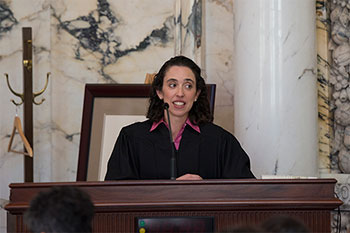
The Honorable Judge Michelle Friedland

  As any experienced district judge knows, some prosecutions are two-attorney cases.
  And some, explains the Ninth, are three.
United States v. Velazquez, 2017 LEXIS 7674 (9th Cir. May 1, 2017), decision available here.

Players: Decision by Judge Friedland, joined by Judge Kozinski and (Sixth Circuit) Judge Gilman.

Facts: Guadalupe Velazquez, a teenager attending Arizona State University on a scholarship, dated a man involved in a marijuana importation conspiracy. Id. at *3. She was charged federally, along with her boyfriend and a dozen or so others. Id. at *4. 
  Her first appointed withdrew after an irreconcilable conflict. Id. 
  Her second attorney, Countryman, was appointed. Id. Countryman missed a deadline to file a suppression motion. Id. Velazquez filed a pro se motion seeking new counsel, citing the missed deadline. She also filed pro se motions related to discovery, trial timelines, and jurisdiction. Id. All motions – including the request for a hearing on new counsel – were denied. Id. at *6. 
  Velazquez later renewed her motion for new counsel. Id. at *8. A magistrate judge engaged in a long dialogue with Velazquez (recounted at length), where the defendant detailed her dissatisfaction with her counsel. Id. at *8-*22. The court continued the hearing. 
  The next day Velazquez accepted an exploding plea offer: she was later sentenced to 121 months. Id. at *6. Id. at *27.

Issue(s): “Quadalupe Velazquez seeks to vacate her guilty plea on the ground that she was constructively denied her right to counsel when the district court denied her motions to substitute counsel without conducting an adequate inquiry.” Id. at *2-*3.

Held: “We agree that the district court abused its discretion in denying Velazquez’s motions and thus vacate the convictions that resulted from her plea.” Id. at *3. 
   “Taken together, the factors weigh in favor of finding an abuse of discretion. . . . [T]he district court abused its discretion by denying Velazquez’s requests to substitute counsel without conducting an adequate inquiry. The result was a constructive denial of counsel that requires us to vacate Velazquez’s guilty plea.” Id. at *38.

Of Note: With forty-to-life hanging over her head (despite her lack of any priors), will young Ms. Velazquez get hammered when she returns to the district court and withdraws her plea? That prospect has occurred to Judge Kozinski. He concurs with Judge Friedland's opinion, and muses, “I hope and trust that the government will accept her choice [regarding withdrawal of the plea] with generosity and compassion.” Id. at *41 (Kozinski, J., concurring). 
  We hope so too.

How to Use: This is a well-written and thorough decision –much to mull for defense counsel wrestling with the problem of a dissatisfied client. 
  Judge Friedland acknowledges that this was Velazquez’s second counsel-firing, but this didn’t obviate the need for an inquiry by the district court given her “specific and serious” allegations. Id. at *32. 
  Note that the detailed Rule 11 colloquy – including a specific inquiry into the relationship with counsel – didn’t immunize the plea from finding of a constructive denial of counsel. Id. at *37-38. Though the judges may have “acted with what they believed to be Velazquez’s best interest at heart,” id. at *41 (Kozinski, J., concurring), when the judges urged the deal they crossed the line into prohibited plea negotiations. Id. at *39-*40. 
  Awaiting on our horizon are more lousy deals, more “exploding offers,” and more understandably-frustrated indigent clients (see “For Further Reading” infra.”) Velazquez is worth a close read before the melee begins.
                                               
AUSA Steven H. Cook
For Further Reading: In 2016, an AUSA from Knoxville Tennessee was disgruntled with President Obama’s efforts to secure sentencing reform. So disgruntled, in fact, that he took vacation time and went to Congress to (successfully) lobby against his boss’s reform initiatives. 
  This former police officer defended the old crack mand-min sentences, blamed crack sentencing reform for (allegedly) increased crime rates, and assured us that racial bias plays no role in who gets federally prosecuted. 
  The prosecutor? Steven H. Cook. See April 2016, "Knoxville News Sentinel" article here; see also video here (where Mr. Cook explains, "I've dealt with these thugs.").
  Many changes, in the year since Mr. Cook's first lobbying efforts. He is now a “top lieutenant” in A.G. Sessions’ DOJ: “Cook’s new perch speaks volumes about where the Justice Department is headed.” See Washington Post article here. 


Steven Kalar, Federal Public Defender N.D. Cal. Website at www.ndcalfpd.org

.

Labels: , , , , ,

Sunday, April 02, 2017

Case o' The Week: Once More Into the Breach - Plascencia-Orozco and Breach of Plea Agreements


Honorable Judge Carlos Bea

 Practice pointer: When an opinion starts by observing that a defendant stands out as a “cara dura,” things probably won’t end well.
United States v. Plascencia-Orozco, 2017 U.S. App. LEXIS 5445 (9th Cir. Mar. 29, 2017), opinion available here.

Players: Decision by Judge Bea, joined by Judges Callahan and Ikuta.

Facts: Plascencia-Orozo stole the I.D. of U.S. citizen “Del Muro.” He attempted unlawful entry using the Del Muro identity in 2008 and 2011. Id. at *4.
  In 2008, Plascencia plead guilty to importation of marijuana: remaining counts were dismissed pursuant to a plea agreement. Id. The plea agreement allowed the dismissed agg ID and reentry charges to be resuscitated in the event of a breach, or if Plascencia unlawfully returned to the U.S. during his term of supervised release. Id. at *11.
  Plascencia was removed after serving his term.
  Two months later, in 2011, he was caught attempting to reenter again, with the “Del Muro” identity.
  Plascencia was charged with agg ID theft and attempted illegal reentry. Id. One set of the agg ID / reentry charges came from the (dismissed) 2008 counts, on a theory Plascencia had breached his ‘08 plea agreement. Id. at *5-*6.
  In a pretrial hearing, the district court found a breach of the plea agreement by a preponderance of the evidence. Plascencia was convicted after trial. Id. at *3, *6.

Issue(s): “Plascencia argues that the district court erred by ruling that Plascencia had breached his 2008 plea agreement at a pretrial motions-in-limine hearing. Instead, Plascencia argues, the district court should have submitted the issue to the jury. Alternatively, Plascencia contends, it should have at least required the government to seek a finding of breach before reindicting Plascencia on the 2008 charges.” Id. at *16.

Held: “We have never squarely held that a district judge may find that a defendant breached a prior plea agreement at a pretrial hearing, without submitting the question to a jury.” Id. at *18 (footnote omitted). “We join the First Circuit in holding that the question of breach is for the district judge, not a jury, to decide.” Id. at *19.

  “We have also never expressly addressed whether the government must seek a judicial finding of breach before indicting a defendant on charges barred by a plea agreement. [W]e think that . . . —a motion to dismiss under Rule 12(b), with an evidentiary hearing to resolve disputed factual issues and a burden of proof that rests squarely on the government—are sufficient to protect a defendant’s due-process right to enforce the terms of his plea agreement. Plascencia has pointed us to no statute or case law requiring the government to seek a preindictment finding of breach, and we decline to recognize such a requirement here.” Id. at *21 (footnote omitted).

  “In sum, we conclude that the proper way for a defendant to raise a prior plea agreement as a defense to a criminal charge is to move to dismiss that charge under Federal Rule of Criminal Procedure 12(b). If the government thinks that the defendant has breached the plea agreement, such that it no longer applies, then it must proffer sufficient evidence to establish that breach by a preponderance of the evidence. . . . The matter need not be submitted to a jury, nor need it be decided before the indictment or information is filed. The district court followed these procedures here, and its ruling at the motions-in-limine hearing that Plascencia had breached his plea agreement was not reversible error.” Id. at *23.

Of Note: The defense of this case was – challenging. Plascencia initiated bar complaints against two attorneys, ended up with three attorneys, and was denied a fourth. He made “an obscene gesture” at a juror, and testified that he was the father of Del Muro’s children (contradicting the testimony of the mother of Del Muro’s children). The only (somewhat) bright spot is the Ninth’s reversal of a “free standing” order that Plascencia to use his true name in the future. Id. at *37-*38.

How to Use: Judge Bea notes (and avoids) conflicted standards of review in the breach context. Id. at *14 n. 8. Despite that sidestep, Plascencia creates new law for breach in the Ninth, and lays out the analysis of breach under the existing rules. It is now a lead Ninth opinion on how to tackle breached plea agreements.
                                               
For Further Reading: Can you exploit a D.J.’s wink, and deliberately breach a plea agreement when a better sentence than the deal is the likely outcome?
  For a good article on this ethical bind, see Can Defense Counsel Ethically Breach a Plea Agreement?, available here.


Steven Kalar, Federal Public Defender N.D. Cal. Website at www.ndcalfpd.org

.

Labels: , , ,

Monday, December 26, 2016

Case o' The Week: "Return to Sender" = Return for Trial: Yepiz and Right to Retained Counsel


Hon. John T. Noonan

 A bounced-back letter means a bounced-back case, when Ninth considers right to counsel of choice.
United States v. Yepiz, 2016 Westlaw 7367827 (9th Cir. Dec. 20, 2016, 2016), decision available here.

Players: Decision by Judge Noonan, joined by Judge Reinhardt. Partial dissent by Judge Nguyen.

Facts: Yepiz and his co-defendants went to trial on RICO charges. Id. at *1. Four months before trial, Yepiz wrote directly to the district judge and complained of difficulties he had with his retained counsel. Id. at *5. The court rejected the letter because local rules prohibit ex parte contact with the judge – but it didn’t explain why in the returned letter. Id. 
  Yepiz wrote another pair of letters asking for an in camera hearing to request appointed counsel. Id. The court ultimately held the hearing, but rejected the request for appointed counsel as “untimely” and on the “eve of trial.” Id. 
  Yepiz wrote a fourth letter with concerns about his counsel during trial. Id.   He appealed after being convicted at trial.

Issue(s): “Unlike most substitution cases that arise when an indigent defendant requests new court-appointed counsel in place of an existing appointed attorney, the present appeal concerns a defendant's request to replace retained counsel with appointed counsel.” Id. at *6 (internal quotations omitted). 
  “Yepiz claims the district court abused its discretion when it failed to inquire into his April letter seeking to replace [retained counsel] Estrada with court-appointed counsel.” Id.

Held: “We agree.” Id. “The right to counsel of choice includes the constitutional right to discharge retained counsel, and a defendant may generally do so for any reason or no reason so long as the substitution would [not] cause significant delay or inefficiency or run afoul of ... other considerations, such as the fair, efficient and orderly administration of justice. . . . [D]enial of a defendant's right to counsel of choice is a structural error, requiring that convictions be vacated even without a showing of prejudice. . . . Where a court allows a defendant to discharge his retained counsel and the defendant is financially qualified, the court must appoint new counsel for him under the Criminal Justice Act (CJA), at any stage of the proceedings. . . .” Id. at *6.
  “We . . . find that the district court abused its discretion when it arbitrarily and without explanation rejected Yepiz's April 2006 letter. Given the defects in the district court's handling of Yepiz's requests, we VACATE Yepiz's conviction and REMAND for a new trial.” Id. at *8 (internal quotations and citations omitted).

Of Note: Structural errors are rarer than hen’s teeth. That standard – structural error – is the crux of Judge Nguyen’s dissent. Id. at *8 (Nguyen, J. dissenting in part). Judge Nguyen would employ a harmless error analysis by characterizing the appeal as alleging ineffective assistance of counsel, not choice of counsel. Id. In her view the case hinges on the status of the pro se letter Yepiz wrote to the court four months before trial (bounced, most likely, by a clerk). Id. at *8. 
  Judge Nguyen worries that “[t]he majority’s holding means that district courts can’t enforce local rules prohibiting represented parties from writing pro se letters to the judge.” Id. at *10. Whether or not that’s true, it is fair to say that Yepiz means that the scribbled letters of our pen pal clients are likely to get a much closer read from their judicial audience.

How to Use: Do we have an ethical obligation to transmit to the court a client’s request for new counsel? Of course, doing so is good form and is the “right” thing to do. But is it an ethical requirement? 
  Yep. 
  “Once Estrada learned that his client might want to discharge him, he had a duty to promptly discuss the issue with Yepiz and, if Yepiz indeed had that intent, to honor it. An attorney has an ethical obligation to seek substitution or withdrawal if his client wants the representation to end.” Id. at *9. The cases relied upon by Judge Nguyen don’t state that obligation quite as bluntly, but note well her rule: if a client wants to fire us, we let the court know.
                                               
For Further Reading: The Eleventh Circuit held this year that a client needn’t show “good cause” to dismiss his retained counsel. See decision here.  
  A case of interest, because the author of Jimenez-Antunez is a lead candidate for the vacant Supreme Court seat. See article here. 


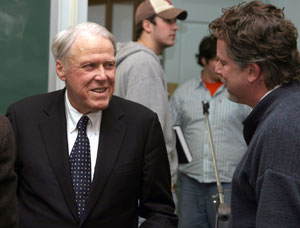
Image of the Honorable Judge John T. Noonan from http://www.wabash.edu/images2/news/Noonan-morrillo-story-1.jpg

Steven Kalar, Federal Public Defender N.D. Cal FPD. Website at www.ndcalfpd.org

.

Labels: , , ,